
Ethiopian Airlines Wins ‘Worst Airline Award’
Ethiopian Airlines Wins ‘Worst Airline Award’
Addis Ababa —The international animal rights group PETA is giving Ethiopian Airlines its Worst Airline Award for transporting thousands of endangered long-tailed macaques from Mauritius and Southeast Asia to the U.S. to be mutilated, poisoned, tormented, and killed in cruel and deadly laboratory experiments. The dishonor comes after trial evidence revealed that the government-owned airline transported multiple shipments containing hundreds of monkeys who were allegedly illegally taken from their forest homes and laundered as “captive-bred”—even though it previously told PETA that shipping monkeys was against company policy.
Ethiopian Airlines is one of the last airlines in the world still flying monkeys to their deaths in laboratories. The practice causes immense suffering to the animals, who are packed into tiny wooden crates, locked inside dark cargo holds, and forced to sit in their own feces, urine, and blood for grueling, hours-long journeys. The airline also transports monkeys on passenger planes—a practice that risks the spread of diseases transmissible to humans.
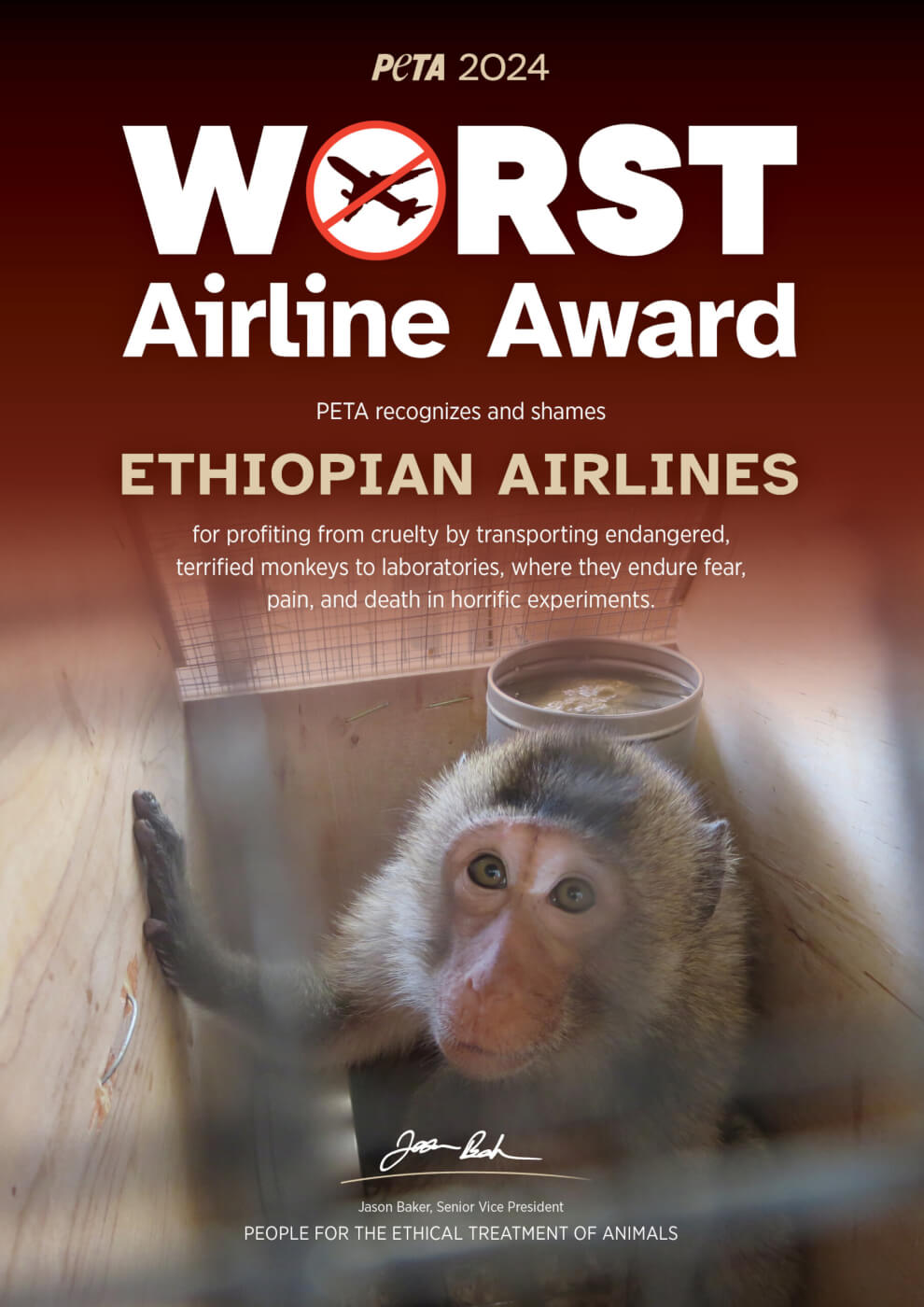
“Ethiopian Airlines is putting terrified monkeys on a one-way flight to pain, suffering, and death in laboratories, and has just as much blood on its hands as the experimenters who wield the scalpels,” says PETA Senior Vice President Jason Baker. “PETA Asia will continue to shame the airline until it gets out of this vile trade, and until then, urges travelers to book their airfare elsewhere.”
Last year, the US Department of Agriculture cited the airline for its failure to provide proper feeding and watering instructions for 336 monkeys crammed inside wooden crates and shipped nearly 16,000 kilometres from Mauritius to the U.S. state of Georgia. The monkeys were left on the tarmac of Hartsfield-Jackson Atlanta International Airport by the ground crew for at least 95 minutes in 30-degree heat. According to federal citations, the airline also imported 584 monkeys into the US without ensuring that the intermediate handler maintained the required health certificates.
In nature, macaques live in large, tight-knit groups, and cuddle together in their favorite “sleeping trees” at night. Long-tailed macaques are classified as endangered by the International Union for Conservation of Nature—and experts have pointed to the capture of hundreds of thousands of macaques for use in the experimentation industry as a driving force in the population’s decline. The industry also poses a grave public and potentially fatal public health risk: Monkeys infected with tuberculosis have been imported to North American labs from Mauritius, while monkeys from Cambodia have arrived infected with a bacterium so deadly that the U.S. classifies it as a bioterrorism agent.
PETA—whose motto reads, in part, that “animals are not ours to experiment on”—opposes speciesism, a human-supremacist worldview. For more information, please visit PETAAsia.com or follow PETA Asia on X, Facebook, or Instagram.
#